

Set Sail for Distant Shores
Co-founder dating, ideas explorations and the first semi-pivot: how it feels to build in uncertainty and other stories from the early startup days.

Hey there,
I wanted to publish this issue about a week ago, but turns out building a startup is taking nearly 100% of my time. Who would have said that, huh!? 👀
In the last month I've been experiencing this new state of mind in which it’s hard to pinpoint exactly what I'm learning (or un-learning). Every day feels like stepping onto shifting sands, making it tough to crystallize my thoughts, let alone write a newsletter!
However, uncertainty is part of the path I’ve chosen, and getting myself together in spite of it is something I must learn. So, no excuses and let’s get started! 🚀
Jokes aside, in the introduction I was just being dramatic. The truth is that writing a newsletter is not the 1st priority for a startup founder. Building the startup has to come first; that's where the real learning happens.
But I stand by what I said earlier, and I'm committed to sharing those lessons with you every month, even when (especially when) things get chaotic. I’ll be more diligent from now on! 🤓
So, how’s this startup engineer life?
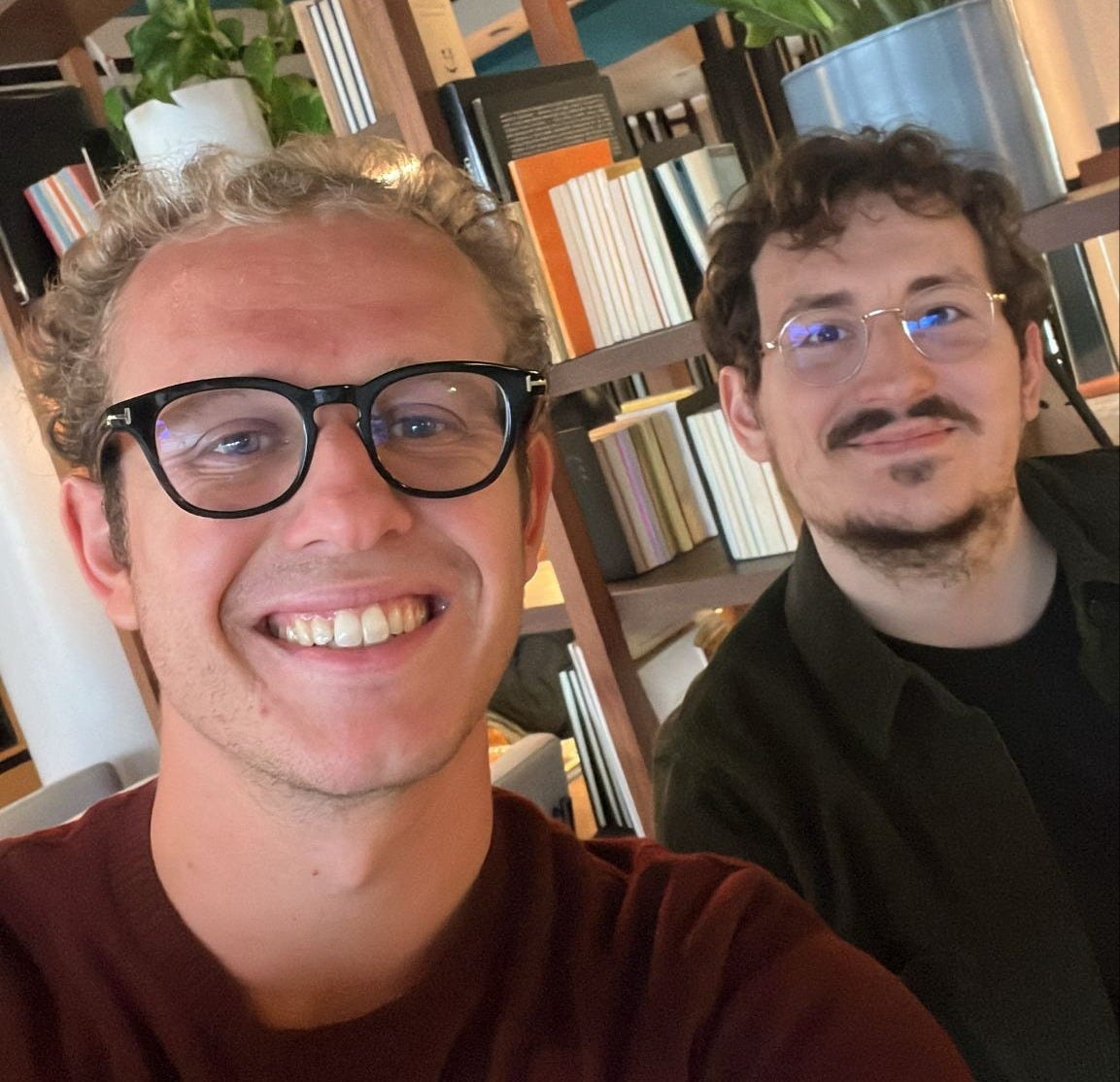
To answer this question, I need to start with what I’ve been working on even before quitting my full-time job. It all started at the Italian Tech Week in Turin, last September. There, I met Giacomo at one of the side-events, an aperitivo organized by a Milan-based VC fund.
We quickly discovered we had the same set of values, and that we had been wanting the same thing for a while: to find the right people and start building something meaningful.
And I’m not gonna lie, that was the whole reason why I was in Turin those days.
After that, we started “virtually dating” for a while, trying to understand if we were a good fit. We followed First Round’s 50 Questions for Co-Founders template to get to know each other, and I can say it really helped going deep in our meetings.
Someone could argue against having such a delicate conversation in a “constrained” format, but I think it was a great way to explore some topics with each other (and with ourselves!) that we wouldn’t have touched otherwise.
It took us around 10 hours spanning several days over a few weeks to complete everything, but I 100% recommend it. A 2019 study in the UK showed that 43% of the surveyed founders were forced to buy out their cofounder due to interpersonal conflicts. Founders break-up is a painful event and a very serious threat for the startup, so investing time in knowing your potential partner better is a wise choice.
Okay nice, but I’d lie if I didn’t tell you that’s barely enough to know you’re not going to hate each other in the first months of working together.
The real test to know if you can work together is… well… working together!
So, around December, we started looking for opportunities in the Healthcare space (the ones who follow me on LinkedIn already knew this).
We focused on all the issues related to Clinical Data management, and how the European regulatory landscape is changing to foster data interoperability. We hoped we could find some interesting opportunities by being among the first ones moving into this space.
It looked extremely promising and we dived into it, learning, interviewing people, challenging existing ideas and beliefs. The more we dug into it, the more we realized how vast the landscape is.
I basically spent 4 full-time weeks studying, but without a clear purpose. I was so down in the rabbit hole that I lost myself into it, getting overwhelmed by the amount of problems and barriers I found.
That inevitably brought me through the very first roller coaster ride that the Startup life is. I reached high peaks when I thought I was very close to figuring it out, and also the lowest points when everything seemed un-solvable.
However, I’m not sure why, but I was never scared, not even for one second.
On the contrary, I was well aware those ups and downs were part of the process, so I just embraced them and put everything into perspective. I tried to get energized by the highs, without fooling myself I had all figured out, and to accept the lows as inevitable, without letting them discourage me from keep going.
We stayed with that topic until very recently. Then we realized we diverged too much, and we were struggling to converge back to some definite MVP with a clear value proposition. When the lows became more frequent, we took it as a signal we needed to change something.
We’ve experienced our first semi-pivot, adapting our direction based on the market feedback. To be more precise, we had in mind a very ambitious plan, but we confused broadness with ambitiousness. So what we were really doing was trying to solve too many problems all at once, because we didn’t really understand the problem in the first place.
We didn’t abandon the space though, we simply re-focused on Clinical Trials. Still quite a broad topic, but we have a much clearer idea of who the potential customers are, and what specific problems we’re able to address.
We see massive potential to improve the way healthcare Providers (hospitals, research centers, etc.) operate as "Sites" for these trials. By optimizing and streamlining their processes, we believe we can dramatically enhance the overall trial efficiency, something that benefits not just the hospitals, but ultimately the Sponsors of these trials, such as Pharma and Biotech companies.
Right now, we're deep in the MVP phase. We drafted three MVP solutions to help researchers with patient screening, enrollment and monitoring. We’re going to test them with some potential customers among providers and sponsors, gathering feedback to decide where to focus next week.
This time we’re doing things differently. We aim to build fast, iterate even faster, and constantly question our assumptions. Who knows? Next month I might be here telling you we've pivoted again a couple of times, but that's the essence of early-stage startups: fail fast, get back up over and over again, each time reaching a little higher than before. Progress only looks like a straight line from the outside.

For all its chaos and unpredictability, I'm having the time of my life. This period is both the hardest and most fulfilling thing I've done professionally.
There’s still much to be done, and having a growth mindset is paramount to reach the goals I set for myself. Hence, here are some of the insights I took away from the last weeks:
I was finding excuses to justify staying in the Analysis Paralysis state. Keep studying feels productive, but it’s just a comfortable way to delay the real work. Now I'm trying to be more intentional and catch when I start justifying “just a bit more research,” asking myself: am I learning or am I hiding?
I'm learning that the discomfort of shipping something “not ready” is actually where the real feedback lives. Plus, there's something energizing about momentum that no amount of planning can replicate.
Finally, and most importantly, I learned I must embrace the uncertainty. I used to think the goal was to reduce uncertainty (doing more research, making better plans, de-risking everything), but that was actually what kept me stuck. The breakthrough for me was realizing uncertainty isn't the enemy to defeat, it's just the terrain I'm walking on. I realized I need to keep going not because of, but in spite of the uncertainty. It’s just the weather I sail through. Some sailors learn to endure storms just to survive them; I want to learn to sail through any weather because I’m chasing distant shores.
Not really rocket science, right? But knowing you shouldn’t do something is not enough to not fall into it. There’s a gap between theory and practice, and I’m learning how to fill it, bringing you with me in the journey. :)
That’s it for today! Thanks for sticking with me through this evolving snapshot. The plan is to publish a new issue every month.
So see you next time, and until then let’s toast to certain uncertainty! Cheers 🍻
PS: If you're in Milan or anywhere in the startup ecosystem and resonate with this chaos, or just want to talk about clinical trials, tech, or startups, let’s grab a coffee! Seriously. Coffee helps.
Further readings:
Make Friends With the Monster Chewing on Your Leg, and Other Tips for Surviving Startups, by First Round
Why Cofounder Partnerships Fail — and How to Make Them Last, by Harvard Business School
The 18 Mistakes That Kill Startups, by Paul Graham